Categories
Filter by price
Color
Kitchen & Home Essentials for Pakistan: Food-Safe Storage, Smart Organization, and Climate-Ready Packaging
Pakistani kitchens operate under conditions that make international product guides largely irrelevant. When your city hits 48°C in June, food safety rules change. When Ramadan arrives, you need storage solutions for 30 days of bulk cooking. When Eid ul Adha comes, you need to safely package and freeze enough meat for months. When monsoon humidity rises to 85%, your spices, flour, and dry goods face mold and pest contamination.
BuyNBazaar's Kitchen & Home range is selected specifically for these realities. Our products are food-grade certified, BPA-free, temperature-tested, and designed for the way Pakistani families actually cook, store, and organize. We do not sell generic imported products with English-only instructions for Western kitchens — we stock solutions that work for biryani, roti, salans, achaar, and the 15 kg of Eid meat your family needs to freeze in one day.
Kitchen Wraps: Cling Film, Aluminum Foil, and Butter Paper for Pakistani Cooking
The kitchen wraps available in Pakistan's local markets are often of unknown food-safety grade. Cheap cling film imported without certification may be PVC-based — and PVC cling film releases di(2-ethylhexyl) adipate (DEHA) and other plasticizers when it contacts hot food or fatty surfaces. This is a real concern in Pakistani kitchens where cling film is routinely used to cover hot biryani, warm daal, and freshly-made desserts.
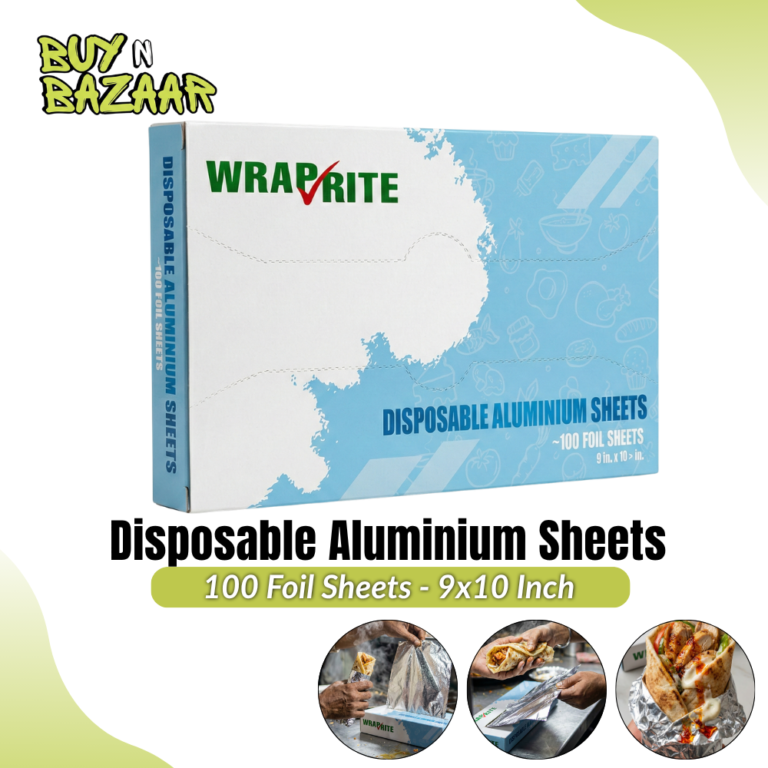
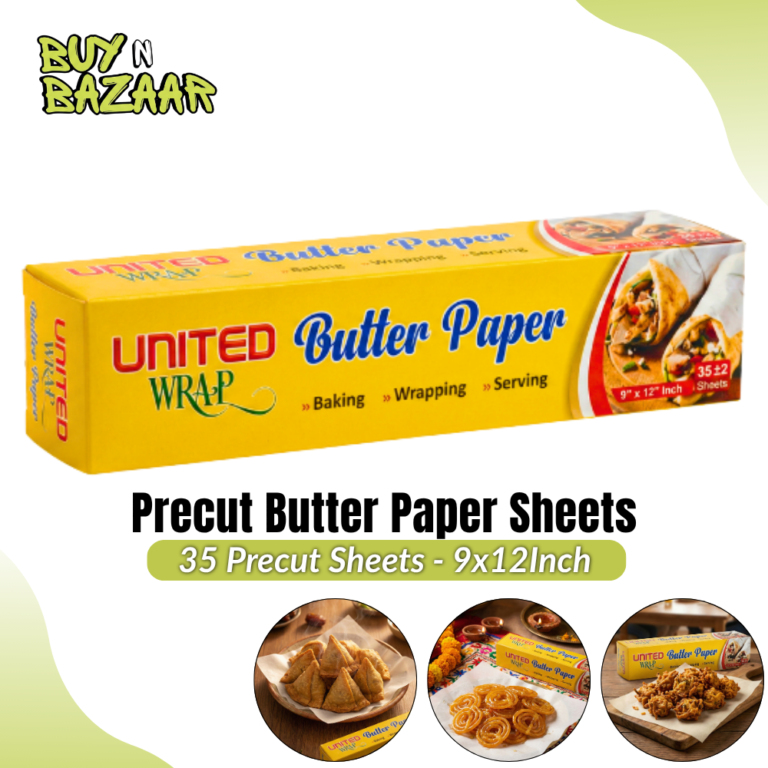
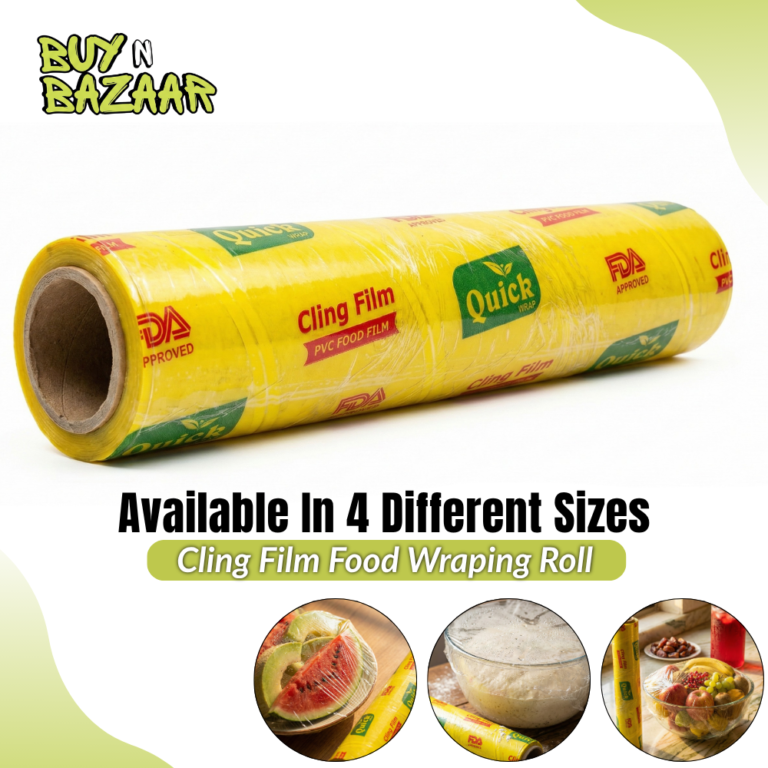
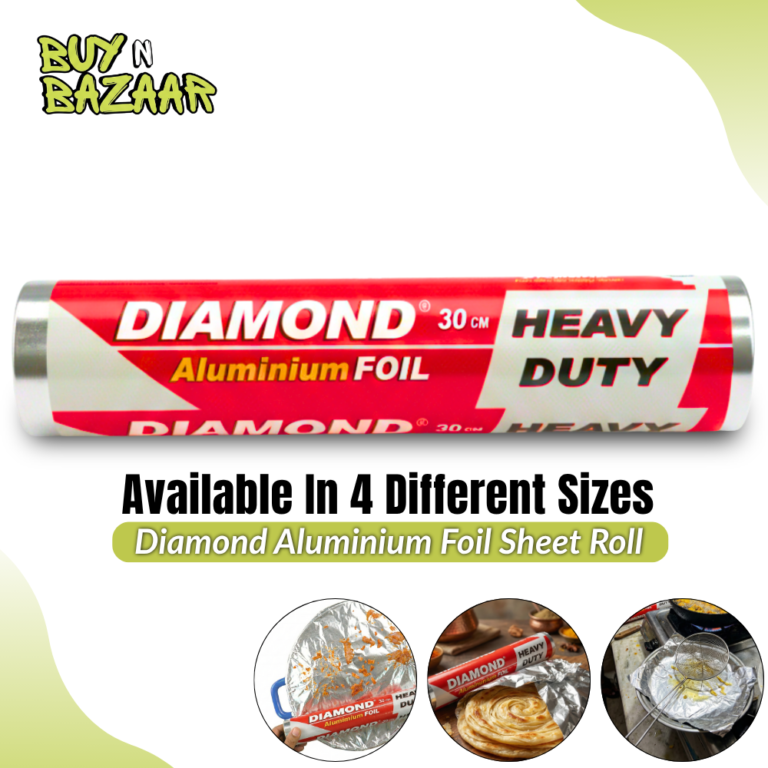
BuyNBazaar stocks only PE (polyethylene) cling film — the food-safe alternative that does not contain PVC or plasticizer chemicals. Our aluminum foil is food-grade certified for direct contact with all food types, including acidic foods like tomato-based salans and citrus marinades (cheap foil can corrode on contact with acid, leaching aluminum into food). Our butter paper is silicone-coated parchment certified for oven use up to 230°C.
Kitchen Wraps Comparison: When to Use What
| Product | Best Use | Heat Limit | Food Contact Safety | Pakistani Kitchen Use |
|---|---|---|---|---|
| PE Cling Film | Covering bowls, wrapping cut fruits, cheese | 60°C (not for hot food) | Safe — no plasticizers | Covering curd, cheese, leftover roti |
| Aluminum Foil | Baking, grilling, wrapping hot food | Up to 660°C | Safe with non-acidic food | Hot roti, kebabs, tandoori, Eid meat |
| Butter Paper | Baking, non-stick lining, wrapping | Up to 230°C | Silicone-coated, food-safe | Naan, pizza, cake baking, cookie sheets |
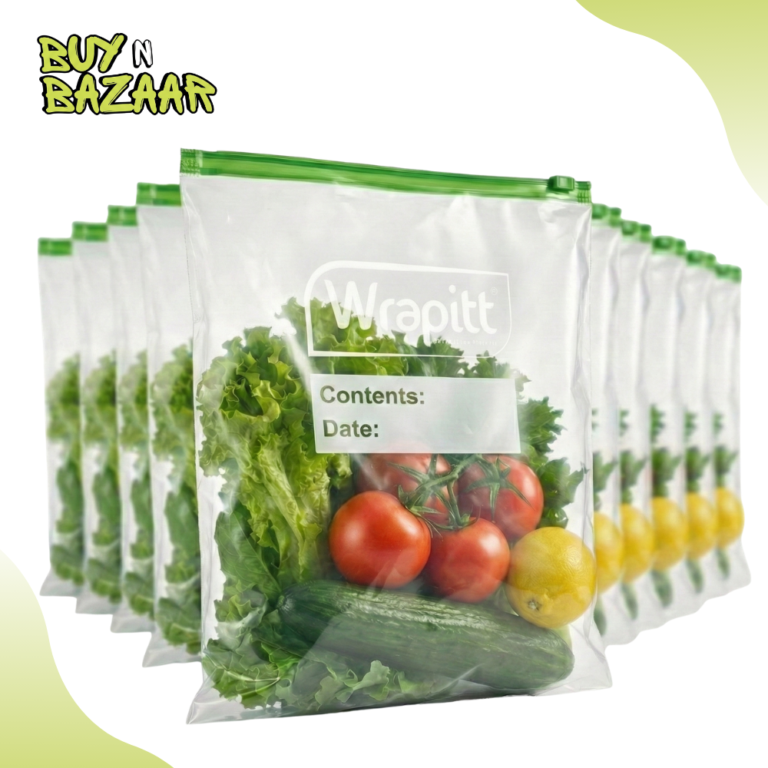
| Zip-Lock Bags | Freezer storage, portion control, marination | -20°C to 80°C | Food-grade PE | Eid meat portions, masala storage |
What Is the Difference Between PVC and PE Cling Film?
PVC (polyvinyl chloride) cling film contains plasticizer chemicals — primarily DEHA and DEHP — that can leach into food, especially when the film contacts hot, fatty, or acidic foods. PE (polyethylene) cling film is plasticizer-free and does not release chemicals on food contact. The European Food Safety Authority (EFSA) and FDA both classify PE cling film as safe for food contact. In Pakistan's markets, most unbranded or locally-sourced cling film is PVC-based because it is cheaper to manufacture and has better cling properties. To identify which type you have: PE cling film stretches smoothly and has a slightly waxy feel, while PVC cling film clings aggressively to itself and has a slight chemical odor when unrolled. For safety, always use PE cling film for food contact, and never microwave any cling film — use a microwave-safe plate or lid instead.
Food Packaging: Zip-Lock Bags, Vacuum Sealers, and Meat Wrapping Solutions
Food packaging in Pakistan is not just about convenience — it is about safety. The Pakistan Food Authority (PFA) reports that food contamination increases 300% during summer months (May-September) and is the leading cause of food-borne illness in Punjab. Proper food packaging — airtight sealing, appropriate temperature storage, and use of food-grade materials — is the primary defense against bacterial contamination.
Our food packaging range includes zip-lock freezer bags in multiple sizes (small for masalas and spices, medium for meat portions, large for whole chickens and bulk items), vacuum sealer bags compatible with home vacuum sealing machines, heavy-duty aluminum foil for Eid ul Adha meat wrapping, and reusable silicone food covers as an eco-friendly alternative to single-use plastic.
For Eid ul Adha specifically, we offer family packs with enough food-grade wrapping material to safely package and freeze 20-50 kg of fresh meat — with printed guidelines on safe meat portioning, wrapping technique, freezing temperature, and thawing methods that comply with PFA food safety standards.
How Long Can You Freeze Meat Safely in Pakistan?
When properly wrapped and stored at -18°C or below in a chest or upright freezer, meat can be safely frozen for the following durations: beef and mutton (8-12 months), chicken (9-12 months whole, 6-9 months pieces), mince/keema (3-4 months), and offal/organ meat (3-4 months). These timelines assume the meat was wrapped airtight — any air exposure causes freezer burn, which degrades texture and flavor but is not a safety risk. In Pakistan, where power outages are common, monitor freezer temperature: if the temperature rises above -12°C for more than 2 hours, move meat to a neighbor's freezer or cook immediately. Never refreeze meat that has fully thawed at room temperature — bacteria multiply rapidly above 4°C. For Eid ul Adha meat, the PFA recommends processing and freezing within 6 hours of slaughter for maximum freshness and safety.
Home Organization: Space-Saving Solutions for Pakistani Apartments and Homes
Pakistani urban housing is getting smaller while families remain large. The average apartment in Lahore's DHA, Bahria Town, and Johar Town developments has a kitchen between 50-80 square feet — roughly a third of the Western kitchen that most organization products are designed for. This means standard freestanding kitchen islands, wide pullout drawers, and pantry systems simply do not fit.
BuyNBazaar's home organization range focuses on vertical storage and wall-mounted solutions that maximize space without floor footprint. Our catalog includes wall-mounted spice racks with 2-3 tier design (keeping 15-20 masala jars accessible without counter space), over-the-door hooks and hanging organizers (using the back of kitchen and bathroom doors), stacking shelf inserts that double your cabinet capacity, corner shelf units that convert dead corner space into storage, under-sink pull-out organizers, and drawer dividers for utensil organization.
How Do I Organize a Small Pakistani Kitchen With Limited Space?
Organizing a small Pakistani kitchen (50-80 sq ft) requires three principles: go vertical, use hidden surfaces, and eliminate counter clutter. Start by installing wall-mounted spice racks to move your masala jars off the counter — a 2-tier wall rack holds 15-20 jars in the space of one dal pot. Use over-the-door hooks on the kitchen door back for aprons, shopping bags, and towels. Install an under-sink pull-out organizer to use the space behind pipes for cleaning supplies. Replace single-level shelves with stacking shelf inserts to double your cabinet capacity. Use a magnetic knife strip on the wall instead of a knife block that consumes counter space. Store roti chaklas and belans vertically using a wall-mounted holder. For the ubiquitous Pakistani spice box (masala dani), switch from a round dabba to a wall-mounted version with labeled compartments. Finally, invest in stackable airtight containers for flour (atta), rice, lentils (daal), and sugar — square containers use 25% less space than round ones.
Safety & Hygiene: Food Thermometers, Cutting Boards, and Antibacterial Solutions
Cross-contamination is the leading cause of food poisoning in Pakistani kitchens, and it happens because most households use one cutting board for everything — raw meat, vegetables, and cooked food. The WHO recommends separate cutting boards for raw meat (red), vegetables (green), and cooked/ready-to-eat food (white) to prevent Salmonella, E. coli, and Campylobacter cross-contamination.
Our safety and hygiene range includes color-coded cutting board sets, instant-read food thermometers (essential for verifying that meat has reached safe internal temperatures: chicken 74°C, beef/mutton 63°C, mince/keema 71°C), antibacterial kitchen mats, and food-safe cleaning solutions. These are not luxury items — in a country where the PFA reports thousands of food contamination cases annually, basic kitchen hygiene tools are a health investment.
Storage Solutions: Airtight Containers, Pantry Jars, and Stackable Systems
Pakistan's climate is the enemy of stored food. Atta (flour) develops weevils within weeks in summer humidity. Ground masalas lose potency when exposed to moisture. Rice absorbs odors from neighboring containers. Sugar clumps. Lentils attract pantry moths. The solution is not more storage — it is better sealing.
BuyNBazaar stocks airtight containers with medical-grade silicone seals rated for temperature extremes from -20°C (freezer) to 120°C (can hold fresh-from-the-stove leftovers). Our storage range includes transparent pantry jars with labeled lids (so you can see contents without opening), stackable modular systems that interlock for stability, BPA-free plastic containers in 500ml to 5,000ml sizes for everything from masalas to monthly atta supply, glass storage jars for achaar (pickle) and preserves (glass does not absorb flavors or colors like plastic does), and steel containers for dry fruit and tea storage.
What Is the Best Way to Store Atta and Spices in Pakistan's Climate?
Store atta (flour) in an airtight container with a silicone-sealed lid, kept in a cool, dry area of your kitchen away from the stove. In Pakistan's summer heat (40-48°C), flour stored in open bags or loosely-covered containers develops weevils within 2-3 weeks. An airtight container prevents moisture entry and pest access. For 10-20 kg monthly supplies, use a large food-grade steel or BPA-free plastic container with a snap-lock lid. Add 2-3 dried whole red chilies or bay leaves (tej patta) inside the container — these are natural insect repellents used in Pakistani households for generations. For ground masalas and whole spices, use small airtight glass or BPA-free jars with tight-fitting lids, stored away from direct sunlight and the stove (heat degrades volatile oils that give spices their flavor). Replace ground masalas every 6 months and whole spices every 12 months for optimal flavor. In monsoon season (July-September), check stored dry goods weekly for moisture or mold.