Filter by price
Baby Teethers Pakistan - Food-Grade Silicone Teething Relief
Baby Teethers Pakistan: Food-Grade Silicone for Safe Evidence-Based Teething Relief
Three common teething approaches in Pakistan are unsupported by evidence and two of them are actively dangerous. Teething gels containing benzocaine or lidocaine: the US FDA banned benzocaine teething products for children under 2 in 2018 because benzocaine can cause methemoglobinemia, a condition that reduces the blood oxygen-carrying capacity and can be fatal in infants. These gels are still available in Pakistan through unregulated channels. Amber teething necklaces: no published clinical study has demonstrated any teething pain relief from amber necklaces. The European Consumer Safety Council classified them as a strangulation and choking hazard. A baby wearing an amber necklace during sleep is at documented risk of strangulation. Honey on the gum: honey is a botulism risk for babies under 12 months. Clostridium botulinum spores in honey produce botulinum toxin in the infant intestine — infant botulism causes paralysis and can be fatal. The correct, evidence-based, WHO and AAP-endorsed teething solution is a food-grade silicone teether that provides mechanical counter-pressure to the swollen gum tissue, directly addressing the cause of teething discomfort without any chemical, choking, or strangulation risk. COD nationwide. Free delivery above Rs.2,999. WhatsApp: 0316-4436660.
When Do Pakistani Babies Start Teething?
The first teeth (lower central incisors) typically erupt between 4 and 7 months. Some babies teethe as early as 3 months, others as late as 12-14 months — both extremes are within the normal range. A baby with no teeth by 18 months should be evaluated by a pediatrician or dentist, as delayed teething can indicate nutritional deficiency (calcium, vitamin D, phosphorus) or thyroid dysfunction. Signs that teething is beginning: excessive drooling (can begin 2-3 months before the first tooth), red and swollen gum over the erupting tooth, increased mouthing and chewing of objects, irritability and altered sleep patterns, and mild fever below 38 degrees Celsius. A fever above 38 degrees Celsius is NOT caused by teething — it indicates illness. Any fever above 38 degrees Celsius in a baby under 6 months requires immediate medical evaluation at Services Hospital Lahore, CMH, or your nearest clinic.
Silicone Teether Types Available at BuyNBazaar Pakistan
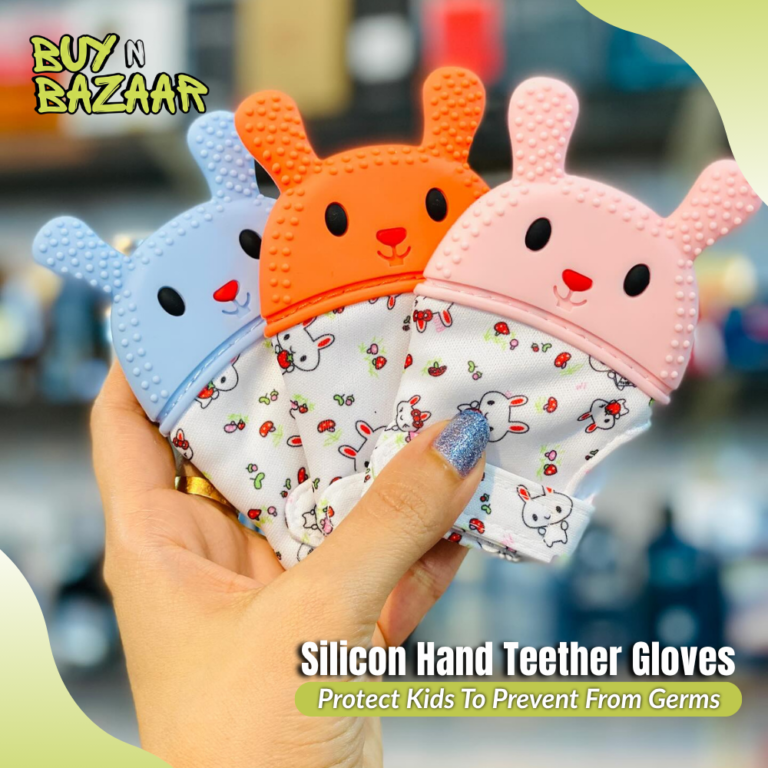
Solid silicone ring (3-6 months): easy to grip with a developing palmar grasp. The ring shape allows the baby to hold and self-direct the teether to the sore gum area. Textured silicone teether (4-12 months): multiple texture zones across the surface provide different pressure sensations on the gum — some babies respond better to firm ridges, others to softer nubs. Experiment to find what provides most relief for your baby. Refrigerated teether (4 months and above): fill with water and refrigerate (4 degrees Celsius) before use. Cold numbs the gum tissue, reducing inflammation and pain. Never freeze — a frozen teether is too hard and bruises the gum tissue, converting a soothing tool into a source of additional pain. Teether-pacifier hybrid (4-12 months): combines a soft silicone nipple for sucking comfort with a chewable textured ring for gum pressure. Useful during the peak teething period when the baby wants both soothing and pressure simultaneously.
How to Sterilize Silicone Baby Teethers in Pakistan
Before first use: boil in rolling water for 3 minutes. For daily maintenance: wash with warm soapy water after each use and rinse thoroughly. Once weekly: boil for 2-3 minutes. Allow to cool completely at room temperature before giving to the baby — a warm teether provides no gum-numbing relief and a hot teether causes burns. Never microwave silicone teethers to sterilize — uneven heating can create hot spots that are not detectable by touch but burn the baby mouth. For refrigerated teethers that are filled with liquid: sterilize by submerging in cold sterilising solution (Milton tablet) for 30 minutes instead of boiling to avoid damaging the liquid-fill valve. Replace any teether immediately if you see tearing, discoloration, or stickiness.
How do I know when my Pakistani baby is ready for a teether?
Three signs indicate a baby is ready for a teether: the baby is putting everything in the mouth and chewing with more than casual interest, the gum line shows a raised, slightly red area over the erupting tooth, and the baby is unusually irritable during what should be normal sleep and feeding times. Most Pakistani babies show these signs between 4 and 7 months. Offer the teether proactively before visible gum swelling appears — early use familiarises the baby with the teether so it is accepted as a comfort tool when pain actually begins.
Can a baby use a teether and a pacifier at the same time in Pakistan?
Yes — they serve different purposes and can be used simultaneously during the teething stage. A pacifier provides oral soothing, helps the baby regulate emotional distress, and provides SIDS protection at sleep time. A teether provides mechanical gum pressure during awake, supervised time. The key rules: use the pacifier for sleeping, the teether for awake supervised play and feeding intervals. Never attach a teether to a string, ribbon, or chain. Never leave a baby unsupervised with a teether and never allow a baby to sleep with a teether in the mouth or cot.
What safe teething remedies do Pakistani pediatricians recommend?
Pakistani pediatricians at CMH Lahore, Services Hospital, and Shaukat Khanum recommend: food-grade silicone teethers (refrigerated but not frozen), clean finger massage directly on the gum with gentle circular pressure, cold damp washcloth for babies 4 months and older, and chilled fruit puree in a mesh feeder for babies over 6 months who have started weaning. For pain that disrupts sleep and feeding, age-appropriate paracetamol (Panadol Infant drops) is the standard recommendation — dose strictly by body weight as directed by your doctor. Avoid ibuprofen for babies under 6 months.
Browse all baby products including orthodontic baby pacifiers, baby feeders, baby grooming kits, and feeding accessories.